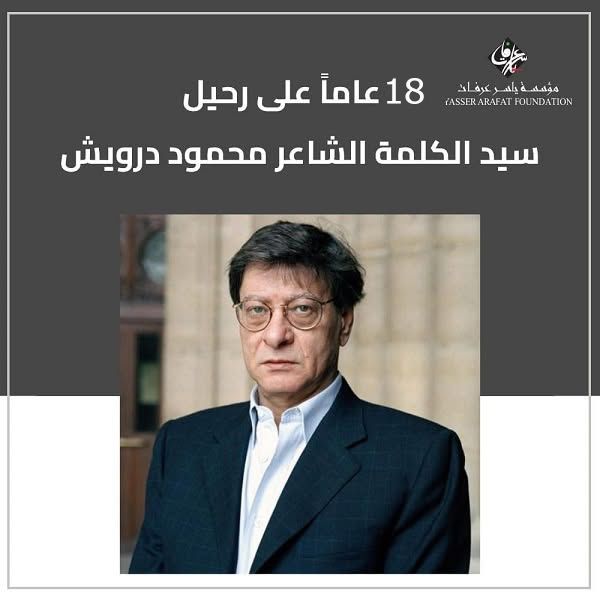
August 9, 2026 marks the 18th anniversary of the passing of Mahmoud Darwish, one of Palestine's most influential poets and one of the most celebrated Arab literary figures of the modern era.
Born in Al-Birwa in the Galilee in 1941, Darwish experienced displacement at an early age, an experience that profoundly shaped his poetry and his understanding of identity, exile, homeland, and belonging. He began writing poetry as a child and emerged as a powerful literary voice for Palestinians, particularly through works such as “Identity Card,” which became an enduring expression of Palestinian identity.
His literary career was closely intertwined with Palestinian political and cultural life. He worked as a journalist and editor, founded and led the literary magazine Al-Karmel, and served on the Executive Committee of the Palestine Liberation Organization. He also played a significant cultural role in the Palestinian national movement, most notably by writing the Palestinian Declaration of Independence proclaimed by Yasser Arafat in Algiers in 1988.
After years of exile and movement between several Arab and European cities, Darwish returned to Palestine in 1996 and settled in Ramallah. His poetry and prose went on to reach audiences around the world, with his works translated into more than 20 languages. He was celebrated both as the poet of Palestinian resistance and as a universal poet whose work addressed themes of humanity, love, freedom, exile, and the search for home.
Darwish died in Houston on August 9, 2008, following heart surgery. He was buried in Ramallah in a site overlooking Jerusalem, which was named “Al-Birwa” in tribute to his birthplace. Nearly two decades after his death, his work continues to occupy a central place in Palestinian cultural memory and in modern Arabic literature.